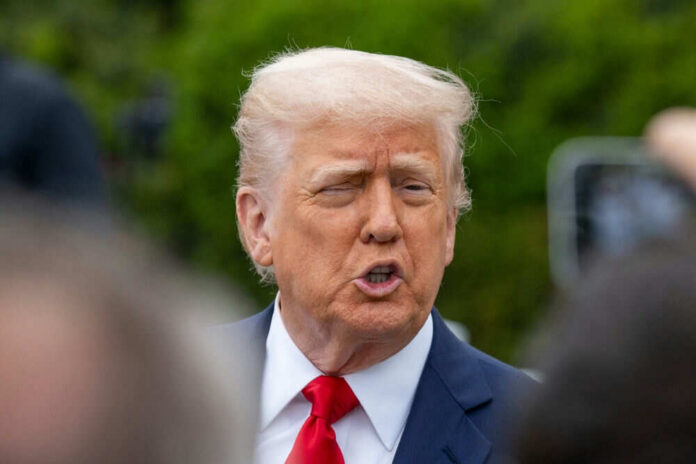
(PatriotNews.net) – After years of “lawfare” talk on both sides, President Trump is now openly weighing preemptive pardons—an escalation Democrats call outrageous, even though it mirrors a Biden-era precedent.
Quick Take
- Reports say Trump has discussed issuing preemptive pardons for administration officials and allies before leaving office.
- The idea gained traction after Democrats, including House Minority Leader Hakeem Jeffries, publicly signaled interest in future prosecutions of Trump officials and ICE agents.
- The White House framed Trump’s “pardon everyone within 200 feet” line as a joke, while emphasizing the broad constitutional pardon authority.
- Supporters argue the move is defensive; critics argue it weakens accountability and normalizes tit-for-tat immunity politics.
What the report says Trump is considering—and why it matters
President Donald Trump has reportedly raised the idea in internal meetings of issuing preemptive pardons for top administration officials and allies, according to an account relayed through a Wall Street Journal report and summarized by PJ Media. One line attributed to Trump—pardoning anyone who came within 200 feet of the Oval Office—was treated by the White House as humor. Still, the broader concept is serious: shielding uncharged individuals from future investigations.
Preemptive pardons sit at the intersection of law and politics because they are not the typical end-of-case relief after a conviction or plea. Instead, they attempt to foreclose prosecutions before charges are even brought. That is precisely why the story set off an immediate online backlash from Democrats, who argued the idea signals wrongdoing. Supporters counter that the point is to prevent politically motivated prosecutions, not to concede guilt.
Democrats’ prosecution talk is shaping the White House calculus
A central driver described in the reporting is a threat-and-response dynamic. PJ Media cites earlier comments from House Minority Leader Hakeem Jeffries suggesting that future prosecutions could target Trump officials and ICE agents, referencing a five-year statute of limitations. For many conservatives, that kind of messaging reads less like neutral oversight and more like a warning that routine enforcement actions could be re-litigated as crimes once political power changes hands.
This dynamic also explains why immigration enforcement personnel are mentioned so prominently. ICE actions are already among the most politically contested parts of federal power, and “accountability” rhetoric can easily morph into selective punishment depending on who controls the Justice Department. The reporting does not show a finalized list of potential pardon recipients or any signed pardons yet. It does show Trump repeatedly raising the concept, implying the administration is at least gaming out the options.
The Biden precedent that complicates Democratic outrage
The strongest factual counterpoint to Democratic criticism is the recent precedent attributed to President Joe Biden. The reporting argues Biden issued preemptive pardons covering family members and high-profile figures such as Dr. Anthony Fauci and members of the January 6 committee, even without prior charges. Former Biden aide Michael LaRosa is quoted characterizing Biden’s actions as having “cracked the door open,” undercutting claims that the idea is uniquely “Trumpian.”
Historically, the Constitution’s Article II pardon power has been interpreted broadly, and preemptive pardons are not unprecedented in American history. The classic modern example is President Gerald Ford’s pardon of Richard Nixon in 1974, issued before Nixon faced charges. The legal availability of the tool, however, does not settle the political question: whether broad preemptive pardons are wise governance. The reporting itself highlights uncertainty about intent, noting Trump “may have been joking” in at least one remark.
What this says about trust, accountability, and the “deep state” era
The bigger story is the continuing breakdown of trust in institutions—especially the idea that law enforcement and prosecution operate above partisan warfare. Conservatives who watched years of investigations and prosecutions aimed at Trump-world see preemptive pardons as a protective shield against a politicized system. Many liberals, meanwhile, view them as evidence that powerful insiders evade consequences. Both reactions point to a shared fear: that regular citizens play by one set of rules while elites negotiate immunity.
Trump Plans to Follow a Biden Precedent, and Democrats Are Flipping Outhttps://t.co/62f6NtFaXV
— PJ Media (@PJMedia_com) April 11, 2026
As of the reporting date, no pardons have been issued, and details remain limited beyond the accounts of meetings and public reactions. That limitation matters because the scope of any eventual pardons—narrow or sweeping—will determine whether the action is seen as targeted defense against retaliatory prosecutions or as a blanket escape hatch. Either way, the precedent cycle is now hard to deny: once one administration uses preemptive pardons to protect allies, the next has a ready-made justification.
Sources:
Trump Plans to Follow a Biden Precedent, and Democrats Are Flipping Out
Lee v. Trump (U.S. District Court, D.C., 2026)
Reviewing Certain Presidential Actions
Trump’s 2025 Executive Orders Chart
Copyright 2026, PatriotNews.net