
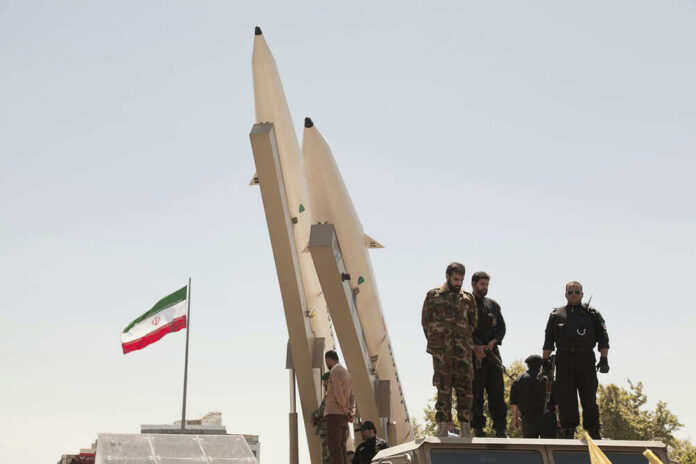
(DailyVantage.com) – President Trump’s promise to keep America out of new wars lies shattered as Iranian missiles rain down on Israeli cities, dragging us into another Middle Eastern conflict that’s costing American lives, depleting our arsenal, and proving once again that regime change wars only breed more chaos.
Story Snapshot
- Iran launched approximately 170 ballistic missiles at Israeli cities on February 28, 2026, killing at least 10 civilians after US-Israeli strikes killed Supreme Leader Ali Khamenei
- President Trump ordered Operation Epic Fury on February 27, initiating direct American involvement in a full-scale war despite campaign promises to avoid new conflicts
- Over 500 Iranian missiles and 2,000 drones fired by March 5, with continued strikes on US bases across Gulf states putting American troops in harm’s way
- MAGA base increasingly frustrated as war drags on with no exit strategy, questioning why American blood and treasure supports another regime change operation
Trump’s War Breaks Campaign Promise
President Donald Trump authorized coordinated US-Israeli airstrikes against Iran on February 27, 2026, using Tomahawk missiles, HIMARS systems, and B-2 bombers in Operation Epic Fury. The strikes specifically targeted Supreme Leader Ali Khamenei, killing him on February 28 in what amounts to a decapitation strike aimed at regime change. This direct military action contradicts Trump’s 2024 campaign pledge to keep America out of new wars, a promise that resonated deeply with conservatives exhausted by two decades of Middle Eastern interventions. The operation involved over 900 strikes by March 6, with American forces actively engaging Iranian targets alongside Israeli Defense Forces, cementing full US involvement in another protracted conflict.
Iranian Retaliation Strikes Israeli Cities
Iran responded to Khamenei’s assassination by unleashing approximately 170 ballistic missiles at Israeli population centers between 09:05 and 10:15 UTC on February 28. The barrage struck Tel Aviv, Haifa, Beit Shemesh, and Jerusalem, overwhelming missile defense systems and killing at least 10 Israeli civilians while wounding dozens more. Beit Shemesh suffered the worst casualties with 9 dead and 65 injured, while Jerusalem reported 6 wounded. By March 12, Iran fired an additional 10 multi-warhead missiles at Tel Aviv, injuring 124 people, demonstrating continued capability despite US claims of degrading their arsenal. The attacks represent Iran’s largest direct missile assault on Israel, surpassing previous 2024-2025 exchanges in scale and lethality, with civilian neighborhoods bearing the brunt of the retaliation.
American Troops Targeted Across Gulf States
Iranian forces expanded their retaliation beyond Israel, systematically targeting US military installations across Kuwait, Bahrain, Oman, and other Gulf states hosting American troops. According to Fars News reports from March 5, Iran directed 60 percent of its strikes at US targets versus 40 percent at Israeli sites, deliberately prioritizing American forces. The Islamic Revolutionary Guard Corps launched missiles and drones at bases throughout the region, forcing port suspensions and disrupting military logistics critical to sustaining operations. By March 6, Iran had fired over 500 missiles and 2,000 drones total since the war’s onset, putting thousands of American service members in constant danger. This multi-front assault strategy aims to exhaust US defenses and strain resources, turning the conflict into exactly the type of prolonged entanglement Trump voters believed they’d avoided.
No Exit Strategy as Costs Mount
Secretary of State Marco Rubio announced on March 4 that attacks would intensify, offering no timeline for American withdrawal or clear victory conditions. The war continues past March 24 with 664 documented US-Israeli attacks by March 6, while Iran maintains retaliatory strikes despite claims of 90 percent missile degradation. US forces struck Iran’s Natanz nuclear facility on March 21 with bunker-busting bombs, further escalating the conflict and risking broader regional war involving Hezbollah, which resumed rocket attacks on Israel. Oil prices spiked, energy costs surged domestically, and travel disruptions mounted as the Strait of Hormuz became a flashpoint. The Mideast Journal reported on March 10 there’s no end in sight, validating conservative fears that regime change operations inevitably spiral into endless commitments draining American resources while failing to deliver promised security.
The conflict has produced over 1,000 total casualties, including 555 Iranian deaths by March 2 and hundreds of injured Israelis, with American forces increasingly exposed across multiple fronts. Iran created a power vacuum following Khamenei’s death that’s destabilizing the region rather than bringing the promised peace, while proxies like Hezbollah exploit the chaos. Conservatives who supported Trump’s America First agenda now watch another generation potentially deployed to fight a war that serves foreign policy establishment interests rather than protecting the homeland. The Constitution grants Congress war powers, yet this escalation proceeded without formal declaration, raising concerns about executive overreach that should alarm any defender of limited government and constitutional constraints on presidential authority.
Sources:
When Will the 2026 Iran War End – Mideast Journal
Timeline of the 2026 Iran War – Wikipedia
Daily Report: The Second Iran War February 28, 2026 – ALMA
Middle East Special Issue March 2026 – ACLED
Copyright 2026, DailyVantage.com