

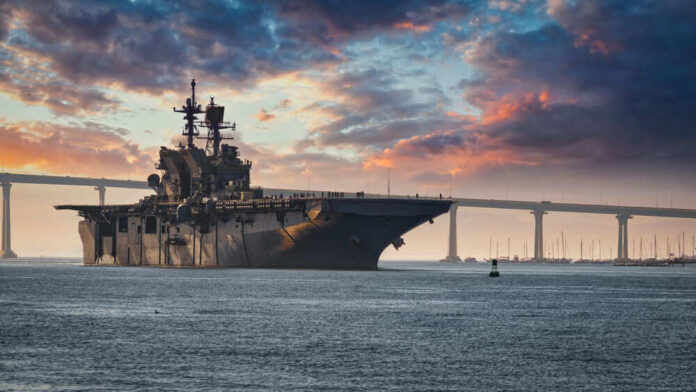
(PatriotNews.net) – Russia has permanently abandoned its only aircraft carrier after wasting over a billion dollars and eight years on a repair fiasco that became a symbol of corruption and strategic failure, leaving the world’s largest nation without the naval power projection it desperately sought.
Story Snapshot
- Admiral Kuznetsov mothballed in fall 2025 after catastrophic repair failures including fires, a sunken drydock, and rampant embezzlement
- Russia becomes the first permanent UN Security Council member without an operational aircraft carrier, ending its carrier aviation era
- Over $1 billion wasted on repairs that never materialized, while 1,500 crew members were reassigned to Ukraine war front
- Russian naval experts publicly endorsed the retirement, calling the carrier obsolete compared to modern drone warfare capabilities
Billion-Dollar Boondoggle Ends in Humiliation
The Russian Navy officially mothballed the Admiral Kuznetsov in late 2025 after suspending modernization efforts that summer, marking the end of Russia’s troubled relationship with carrier aviation. The decision came after eight years of catastrophic repair attempts that began in July 2017, plagued by a series of disasters including a massive crane collapse in 2018, the sinking of the critical PD-50 drydock, and a fatal fire in 2019 that killed two workers. United Shipbuilding Corporation, which managed the repairs, declared further investment unjustifiable after spending over 100 billion rubles with nothing to show for it.
Launched in 1985 as the Soviet Navy’s flagship, the Admiral Kuznetsov was designed to carry 26 fixed-wing aircraft and 24 helicopters for air superiority and support missions. The vessel last saw operational deployment off Syria in 2016-2017 before entering what was supposed to be routine maintenance. Instead, corruption, mismanagement, and the prioritization of resources for the Ukraine war transformed the overhaul into a national embarrassment. By September 2024, the Russian Defense Ministry had reassigned the carrier’s 1,500 sailors to combat duty in Ukraine, signaling the vessel’s true fate months before the official announcement.
Strategic Shift Reflects Changing Warfare Reality
Admiral Sergei Avakyants, former Pacific Fleet commander, publicly endorsed the mothballing decision in July 2025, calling it “absolutely the right step” and describing the Kuznetsov as “from another era.” Avakyants argued that modern naval warfare has evolved beyond expensive carrier operations toward unmanned robotic systems and drone technology, making the aging vessel “very expensive and ineffective.” His comments reflect a broader strategic pivot by the Russian Navy away from blue-water power projection toward submarines and autonomous systems, driven partly by technological advancement and partly by the resource demands of the ongoing Ukraine conflict.
The carrier’s troubled history stretches back years before its final repair attempt. Chronic mechanical problems, including persistent fires dating to 2009, earned it a reputation as a maintenance nightmare. The 2018 sinking of the PD-50 drydock, which was essential for hull repairs, effectively doomed any hope of returning the ship to service on schedule. Embezzlement allegations surrounding the repair contracts further eroded confidence, while the United Shipbuilding Corporation’s optimistic 2022 projections of a 2024 return to service and 25 years of additional operations proved wildly unrealistic. These failures mirror Soviet-era carrier troubles, including the unfinished Ulyanovsk project, demonstrating persistent institutional problems in Russian naval shipbuilding.
Global Implications of Naval Decline
Russia now stands alone among permanent UN Security Council members without an operational aircraft carrier, a distinction that undermines its claims to great power status and global reach. The economic impact extends beyond the immediate waste of over a billion dollars, affecting shipyard workers who relied on the modernization work and exposing the hollowness of Russian military prestige. Western naval analysts, including those at Forbes and 19FortyFive, uniformly describe the mothballing as overdue, with Christian Orr calling the Kuznetsov an “accursed” ship whose retirement was “absolutely correct.” The United States Naval Institute noted this closes Russia’s “troubled history with carrier aviation” with no replacement vessels planned.
No More Aircraft Carriers for Russia: Admiral Kuznetsov Will Never Sail Againhttps://t.co/wspdXyrrsO
— 19FortyFive (@19_forty_five) March 30, 2026
The broader implications signal a fundamental shift in naval power dynamics. While Russia’s decision partly reflects its unique financial constraints and prioritization of the Ukraine war, it also acknowledges the growing vulnerability of large surface vessels to modern anti-ship missiles and drone swarms. For Americans concerned about defense spending and endless military commitments, Russia’s carrier debacle offers a cautionary tale about prestige projects that consume resources without delivering strategic value. The question remains whether other nations, including the United States, will draw appropriate lessons about balancing traditional naval power with emerging unmanned technologies rather than pouring money into increasingly vulnerable platforms.
Sources:
In 2025, Russia Will Finally Lose Its Only Aircraft Carrier – Charter97.org
Russian aircraft carrier Admiral Kuznetsov – Wikipedia
The Russian Navy Will Soon Have No Aircraft Carriers – 19FortyFive
Admiral Kuznetsov Repair Problems – www1.ru
The End of Russian Carrier Dreams: Kuznetsov Scrapped After Billions Wasted – Defense Magazine
Russian Carriers – U.S. Naval Institute
Copyright 2026, PatriotNews.net