
(PatriotNews.net) – America’s $13 billion nuclear supercarriers—the crown jewels of naval power projection now deployed against Iran—may be floating death traps vulnerable to million-dollar torpedoes that our enemies can afford by the dozen, raising urgent questions about whether we’re risking thousands of sailors’ lives on overpriced targets while draining taxpayer wallets in yet another Middle East quagmire.
Story Snapshot
- Modern supercarriers costing $13 billion remain untested against inexpensive wake-homing torpedoes priced around $1 million that exploit underwater blind spots in carrier defenses.
- Historical exercises prove the threat is real: a Canadian diesel submarine costing $80 million simulated sinking the USS Dwight D. Eisenhower in 1981 by slipping past destroyer screens undetected.
- Carrier strike groups optimize defenses against air and missile threats but face critical vulnerabilities from torpedoes that detonate below the keel, snapping the ship’s spine through gas bubble physics.
- With America now engaged against Iran in contested waters like the Persian Gulf, adversaries possessing cheap diesel submarines and torpedoes could inflict catastrophic losses on our most expensive warships.
The Billion-Dollar Vulnerability No One Wants to Discuss
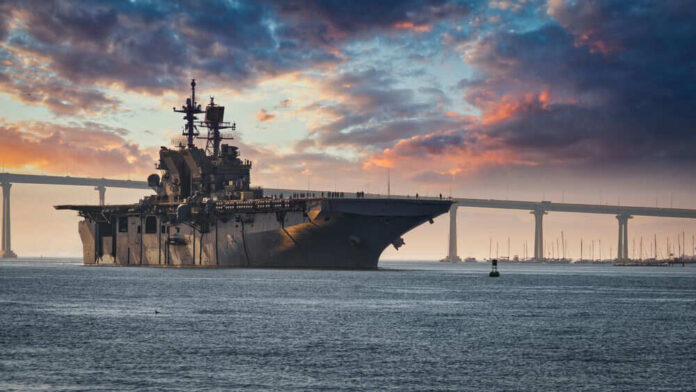
The U.S. Navy operates supercarriers like the Gerald R. Ford-class at a staggering $13 billion per vessel, protected by destroyers, cruisers, submarines, and air wings in carrier strike groups designed to project American power worldwide. These floating cities carry over 5,000 personnel and represent the pinnacle of naval engineering. Yet defense analysts now warn these behemoths face a stark vulnerability: inexpensive wake-homing torpedoes costing roughly $1 million can potentially sink them by exploiting gaps in underwater defenses optimized for aerial and missile threats. This cost asymmetry—$13 billion versus $1 million—represents a David versus Goliath scenario that should alarm every American taxpayer funding these deployments, especially with carriers now operating in hostile Iranian waters.
When a Cheap Canadian Sub Humiliated the U.S. Navy
History validates these concerns through the 1981 Ocean Venture NATO exercise in the North Atlantic, where the Canadian diesel-electric submarine HMCS Okanagan—costing approximately $80 million—simulated a successful torpedo attack on the USS Dwight D. Eisenhower, a Nimitz-class carrier valued at $5.5 billion. The Okanagan penetrated the carrier’s protective screen of destroyers, sonar systems, and aircraft by running silent on battery power, exploiting acoustic blind spots in the defensive perimeter. NATO exercise umpires officially declared the carrier “sunk,” demonstrating that skilled crews in modest diesel submarines can threaten nuclear-powered platforms through superior stealth tactics. This wasn’t theoretical—it happened during a realistic combat simulation with allied forces.
The Physics of Carrier Destruction
Torpedoes achieve devastating effects through underwater physics that date to World War II, when they routinely sank carriers and battleships. A torpedo detonating beneath a ship’s keel creates an expanding gas bubble that lifts the vessel momentarily before the bubble collapses, causing the unsupported hull to snap under its own weight. This keel-breaking mechanism bypasses armored hulls and compartmentalization that might survive direct impacts. Modern wake-homing torpedoes track the distinctive water disturbances created by massive ships, making evasion nearly impossible for a 100,000-ton carrier. Despite shock trials on vessels like the USS Gerald R. Ford in 2021 using explosives to test structural resilience, no modern supercarrier has faced actual heavyweight torpedo hits—survivability remains theoretical, unproven in combat conditions.
Iran’s Asymmetric Advantage in the Gulf
The current conflict with Iran magnifies these vulnerabilities exponentially. Iranian forces operate diesel-electric submarines and possess anti-ship torpedoes in the shallow, acoustically noisy waters of the Persian Gulf and Strait of Hormuz—precisely the littoral environments where carrier strike group anti-submarine warfare capabilities face maximum difficulty. Diesel submarines running on batteries produce minimal acoustic signatures, making detection challenging even with advanced sonar systems. Active sonar, which could improve detection, risks revealing the searching vessel’s position to enemy forces. Iran doesn’t need technological parity; a single successful torpedo strike from a submarine costing a fraction of a carrier’s price could kill thousands of American sailors and eliminate a cornerstone of U.S. military power, handing our enemies a propaganda victory while validating their asymmetric warfare strategy.
A $13,000,000,000 Nuclear Aircraft Carrier Could Be Sunk by $1,000,000 ‘Cheap’ Torpedohttps://t.co/9G5tvG9AXp
— 19FortyFive (@19_forty_five) March 23, 2026
Why This Matters for America First Conservatives
This vulnerability exposes the folly of endless military interventions that President Trump promised to end but has now escalated in his second term. American taxpayers fund $13 billion carriers and their multi-billion-dollar strike groups to project power in Middle Eastern conflicts that serve questionable national interests, while our own border remains unsecured and infrastructure crumbles. The cost asymmetry—where adversaries can threaten our most expensive assets with weapons they can afford by the dozens—mirrors the unsustainable spending that fueled inflation and economic hardship at home. We risk thousands of sailors’ lives on platforms potentially vulnerable to cheap, proven threats, all while draining resources that could strengthen America domestically. The defense establishment prioritizes high-cost carrier construction over addressing fundamental survivability questions, perpetuating a cycle of overpriced, potentially obsolete weapons systems that enrich contractors while leaving our military exposed in conflicts that don’t serve America First principles.
Sources:
USS Dwight D Eisenhower Carrier Sunk by 80 Million Dollar Canadian Submarine – Indian Defence Review
A $13,000,000,000 Nuclear Aircraft Carrier Could Be Sunk by $1,000,000 ‘Cheap’ Torpedo – 19FortyFive
Copyright 2026, PatriotNews.net