(PatriotNews.net) – Trump’s “end of a civilization” warning to Iran is being recast by the White House as a deadline-driven move to reopen a key global oil chokepoint—before energy prices and U.S. credibility take the hit.
Quick Take
- Vice President JD Vance defended President Trump’s ultimatum to Iran tied to an 8 p.m. ET Tuesday deadline involving the Strait of Hormuz.
- Vance described “two pathways”: Iran can rejoin “normal” economic relations or face deeper economic damage and possible U.S. strikes on infrastructure.
- The administration argues the immediate crisis is Iran’s disruption of Hormuz shipping, a major artery for global oil, which Vance labeled “economic terrorism.”
- Reporting indicates U.S. and allied strikes have been underway for weeks, with U.S. officials claiming major military objectives are largely achieved.
Vance’s Defense: Pressure Campaign Framed as Diplomacy
Vice President JD Vance used appearances abroad and in front of cameras Tuesday to defend President Donald Trump’s unusually stark language toward Iran. Vance argued the White House is presenting Tehran with a clear choice: accept a deal that ends nuclear ambitions and support for terrorism, or face worsening economic isolation and U.S. military action. In this framing, harsh rhetoric is treated as leverage designed to force compliance rather than an announcement of inevitable escalation.
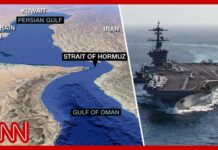
Vance’s public comments also emphasized timing. Multiple outlets reported an 8 p.m. ET Tuesday deadline linked to reopening the Strait of Hormuz, after Iranian actions threatened shipping in the corridor. The administration’s message to Iran, as relayed by Vance, is that the U.S. prefers a negotiated outcome but is willing to impose costs quickly if the strait remains disrupted. That deadline focus matters because markets often respond to perceived risk faster than governments can negotiate.
Why the Strait of Hormuz Keeps Showing Up in U.S. Strategy
The Strait of Hormuz is not a symbolic talking point; it is a practical pressure point. Reporting in the provided research notes that roughly 20% of global oil transits through the strait, which means disruptions can ripple into gasoline prices and broader inflation pressures. Conservatives who remember the economic damage of recent inflation spikes will recognize why the administration is treating shipping access as a core national interest rather than a distant regional dispute.
Vance characterized Iran’s obstruction as a form of “economic terrorism,” a phrase that signals the White House views the tactic as coercion aimed at civilians and economies rather than a conventional military engagement. That language is politically significant in 2026 because it attempts to justify a firm response without committing the U.S. to open-ended nation-building. It also reflects a broader trend: U.S. presidents are increasingly judged at home by energy and cost-of-living consequences tied to foreign conflicts.
Escalation Risks: Infrastructure Threats and Civilian Fallout
The reporting also describes what the U.S. threatened if Iran did not comply—strikes on power plants and bridges. That kind of target set raises the stakes because it can directly affect civilian life inside Iran. Supporters of limited government and restrained foreign policy often worry about mission creep; critics of Iran’s regime, meanwhile, argue that decisive pressure is sometimes the only language Tehran respects. The available sources do not resolve that debate, but they document the policy dilemma clearly.
Iran, for its part, signaled defiance and framed U.S. actions as unlawful. The research cites Iran’s U.N. envoy warning of self-defense and describing U.S. threats in severe terms, while other reports referenced vows of “immediate proportionate” response. This is where the lack of independent expert analysis in the dataset becomes a limitation: audiences are mostly hearing from the stakeholders themselves, each with an incentive to frame actions as either deterrence or aggression.
What to Watch After the Deadline: Deterrence, Energy, and Trust in Government
Even before any post-deadline outcome is known, the episode highlights a broader political reality: Americans across parties increasingly doubt that Washington’s foreign-policy decisions are made with transparency or long-term accountability. Conservatives may see an overdue show of strength after years of mixed signals, while many on the left will see reckless rhetoric. What is firmly supported by the research is that the administration believes the military campaign has achieved major objectives and is now trying to convert that advantage into a deal.
The immediate practical questions are straightforward: Did Iran reopen the strait, did the U.S. follow through on threats, and what happened to shipping risk and energy pricing? The political questions are harder: whether maximalist rhetoric strengthens deterrence or widens the path to escalation, and whether Americans trust the same federal institutions—security agencies, diplomats, and political leaders—that have repeatedly promised quick outcomes in the Middle East. The provided reporting captures the brinkmanship; the aftermath will test credibility.
Sources:
Vance says Iran faces two pathways as deadline nears in escalating conflict
Vance says Iran faces two pathways as deadline nears in escalating conflict
Vance humiliated as Trump doesn’t pick up call live on stage
Copyright 2026, PatriotNews.net