

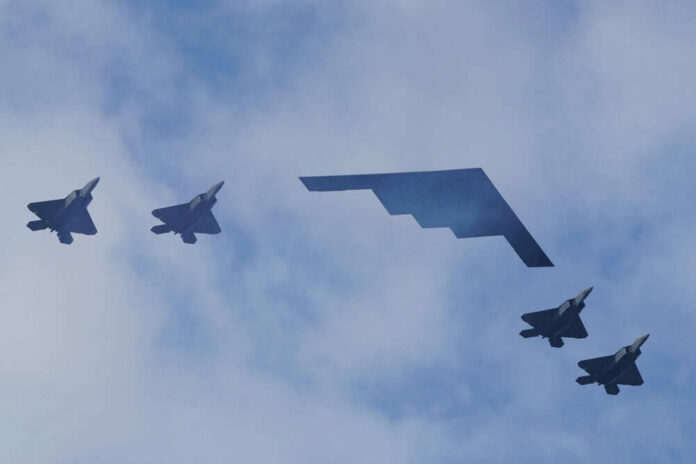
(PatriotNews.net) – Boeing’s radical new F-47 fighter jet completely abandons traditional tail structures in a groundbreaking design that makes America’s next-generation air dominance platform virtually invisible to enemy radar—a technological leap that ensures our pilots will dominate the skies while adversaries like China and Russia scramble to catch up.
Story Highlights
- F-47 eliminates all vertical stabilizers and tail fins, using blended wing surfaces to drastically reduce radar signature beyond current stealth fighters
- Boeing’s tailless design represents deliberate trade-off prioritizing extreme stealth over conventional aerodynamics, challenging decades of fighter aircraft design assumptions
- First prototype under construction with 2028 first flight target; Air Force plans to procure 185+ aircraft for operational deployment in 2030s
- Trump administration touts F-47 as having “the most power of any jet of its kind ever made” with unmatched maneuverability capabilities
Revolutionary Design Breaks from Fighter Tradition
Boeing’s F-47 represents the most radical departure from conventional fighter design in decades, completely eliminating the vertical tail structures that have defined combat aircraft since the dawn of aviation. The tailless configuration employs smooth, uninterrupted blended wing surfaces specifically engineered to minimize radar cross-section. Traditional vertical stabilizers create distinctive radar reflections that are nearly impossible to suppress—by removing them entirely, Boeing has addressed one of the most persistent challenges in stealth aircraft design. This architectural choice reflects decades of research into low-observable technology, representing the logical evolution of principles first demonstrated in platforms like the F-117 Nighthawk.
Stealth Prioritized Over Aerodynamic Convention
The F-47’s design philosophy deliberately accepts certain aerodynamic compromises to achieve unprecedented stealth capabilities. Boeing integrated forward canards positioned behind the cockpit—features historically considered incompatible with low-observability requirements due to their radar-reflective properties. However, advanced flight-control software and careful shaping minimize their radar signature while enabling superior maneuverability and sustained high-speed flight. The aircraft will feature next-generation all-aspect broadband low-observability, including significantly reduced infrared signature. This represents a fundamental shift from the F-22’s design approach, which balanced conventional aerodynamic efficiency with stealth. The F-47 prioritizes survivability in contested airspace above all else, directly addressing the threat posed by advanced integrated air defense systems developed by near-peer adversaries.
Program Accelerates Toward 2028 First Flight
Boeing received the engineering and manufacturing development contract in March 2025, signaling Air Force confidence in the tailless design approach. The first prototype is currently under construction, with first flight scheduled for 2028. Air Force Chief of Staff General Allvin emphasized the aircraft represents “a generational leap forward” from the F-22, with “unprecedented maturity” at this program phase. The accelerated timeline reflects technology maturation from NGAD X-Plane efforts conducted during the Trump administration’s first term. The Air Force intends to procure 185-plus aircraft for operational fielding in the 2030s. Boeing’s selection strengthens American industrial capabilities at a critical moment when China and Russia are advancing their own sixth-generation fighter programs.
Superior Capabilities at Lower Cost Than F-22
The F-47 will deliver significantly longer range, more advanced stealth, higher availability, and better sustainability than current fifth-generation fighters—while costing less than the F-22 Raptor it will eventually replace. The aircraft will achieve speeds exceeding Mach 2 with a combat radius over 1,000 nautical miles, enabling long-range operations deep into contested airspace. Advanced adaptive-cycle engines from either General Electric or Pratt & Whitney will provide unprecedented thrust and fuel efficiency. The F-47 will operate as a command node for collaborative combat aircraft—autonomous drones that extend the pilot’s reach and lethality. This capability fundamentally transforms air warfare doctrine, moving away from traditional dogfighting toward penetration of defended airspace and rapid engagement at extended ranges.
The F-47 NGAD Stealth Fighter Has No Fins, No Tails, and No Vertical Structures — That Design Choice Is How It Disappears From Enemy Radar Entirelyhttps://t.co/zzN8ZePmv7
— 19FortyFive (@19_forty_five) March 18, 2026
The F-47 NGAD program demonstrates what American innovation achieves when freed from the bureaucratic paralysis and cost overruns that plagued defense acquisition during previous administrations. Boeing’s willingness to challenge conventional design assumptions—eliminating structures that have defined fighter aircraft for generations—reflects the bold thinking necessary to maintain air superiority against increasingly sophisticated adversaries. The tailless configuration may become the industry standard for sixth-generation fighters worldwide, establishing American technological leadership for decades to come. As the first prototype takes shape, our Air Force moves closer to fielding a capability that will ensure American pilots dominate any contested airspace, protecting our national security interests and those of our allies.
Sources:
F-47 Program’s Accelerated Pace Made Possible By NGAD X-Plane Efforts – The War Zone
Everything We Know About Boeing F-47 NGAD – The Aviationist
New U.S. Air Force F-47 NGAD Stealth Fighter Might Have Just Broke Cover – 19FortyFive
First F-47 Now Being Built Will Fly in 2028 US Air Force Chief – Defense News
New F-47 F-22 Allvin – Air & Space Forces Magazine
Copyright 2026, PatriotNews.net