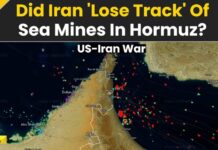
(PatriotNews.net) – President Trump just turned a strategic choke point into a red line—warning Iran that any fast attack ship approaching the U.S. blockade in the Strait of Hormuz will be “immediately ELIMINATED.”
Story Snapshot
- President Trump issued a Truth Social warning on April 13, 2026, threatening to “immediately ELIMINATE” Iranian fast attack ships that approach the U.S. naval blockade.
- The U.S. blockade of Iranian ports began at 10 a.m. ET after weekend peace talks collapsed, with U.S. Central Command warning vessels they may be intercepted, diverted, or captured.
- Iran condemned the blockade as “piracy” and vowed retaliation, raising the risk of renewed clashes despite a fragile ceasefire.
- The Strait of Hormuz remains a global economic pressure point, with potential spillover into oil, fertilizer, and broader shipping disruptions.
Trump’s Warning Raises the Stakes at a Vital Chokepoint
President Donald Trump escalated U.S. messaging on April 13, 2026, after the Navy began enforcing a blockade on Iranian ports in and around the Strait of Hormuz. Trump’s post singled out Iranian fast attack vessels, warning that any that come near the blockade “will be immediately ELIMINATED,” describing the method as “quick and brutal” and comparing it to systems used against drug boats. The warning followed the blockade’s 10 a.m. ET start.
U.S. Central Command’s notice to mariners framed the operation in operational, not rhetorical, terms: vessels transiting to or from Iranian ports without authorization could face “interception, diversion, and capture.” Early reporting said it was not immediately clear whether interdictions had begun right after the start time, but the enforcement posture was presented as active. The combination of a formal maritime notice and the president’s blunt language signals deterrence as the primary objective.
How the U.S.-Iran Track Broke Down into Blockade Enforcement
The immediate backdrop is diplomatic failure. Reports indicated marathon peace talks over the April 11–12 weekend collapsed without an agreement, and Trump soon announced the blockade would begin the morning of April 13. In the coverage, Trump also referenced earlier U.S. operations that he said had severely damaged Iran’s navy, including claims that 158 ships were sunk. Those figures were attributed to the president’s statements, and were not independently verified within the live updates.
The blockade’s focus on Iranian ports rather than a full closure of the Strait still matters because the region functions as a single economic system. The Strait of Hormuz is a narrow corridor for energy and commercial traffic linking the Persian Gulf to the wider world. Even limited disruption can create broader uncertainty for insurers, shipping schedules, and commodity markets. The research also notes fertilizer and goods shipments as part of the trade mix, widening the impact beyond gasoline prices.
Iran’s “Piracy” Claim and the Risk of Retaliation
Iran’s government condemned the blockade as illegal “piracy” and warned of forceful retaliation, with reports suggesting threats that could extend beyond U.S. ships to regional ports. That reaction creates a familiar dilemma for American policymakers: deterrence can prevent attacks, but it can also provoke asymmetric responses if an adversary believes it must reassert credibility. With Iran’s conventional naval capacity portrayed as badly degraded, fast attack craft become more politically and tactically significant.
Why This Matters at Home: Security, Prices, and Trust in Government
For U.S. voters, the immediate test is whether the administration can keep shipping lanes secure without sliding into an open-ended conflict. Conservatives tend to support clear deterrence when U.S. forces and trade routes are threatened, but they also remember decades of costly Middle East entanglements sold with shifting rationales. Many liberals, meanwhile, may see the blockade as dangerous escalation, especially if it pushes energy prices up and hits working families first.
The broader political friction is also about credibility. In 2026, with Republicans controlling Congress and Democrats aggressively opposing Trump’s agenda, foreign policy events like this become fuel for domestic narratives—either proof that strength works or evidence that Washington is reckless. What’s missing in the early coverage is independent expert analysis, which limits certainty about second-order effects. For now, the known facts are the blockade start, the operational warning to shipping, and the president’s explicit threat.
Trump Says Any Iranian Ship Near U.S. Blockade Will Be ‘ELIMINATED’https://t.co/epx8Vz12Yu
— PJ Media (@PJMedia_com) April 13, 2026
The next indicators to watch are straightforward: whether interdictions actually occur, whether Iran tests the blockade with fast attack boats, and whether commercial carriers reroute or pause voyages due to risk. If the Strait becomes more dangerous—even briefly—the economic consequences can reach American households quickly through energy and shipping costs. In a country already skeptical of “elite” decision-making, every development will be judged against one question: is Washington protecting ordinary Americans, or gambling with their livelihoods?
Sources:
https://www.foxnews.com/live-news/trump-iran-blockade-strait-hormuz-israel-april-13
https://www.cbsnews.com/live-updates/iran-war-us-iran-ports-blockade-strait-of-hormuz-trump/
Copyright 2026, PatriotNews.net