
(PatriotNews.net) – Iran’s rapid rebuild of a massive missile arsenal is the kind of hard-power reality check that punishes wishful “diplomacy” and puts American troops and allies back in the crosshairs.
Quick Take
- Multiple reports estimate Iran has rebuilt to roughly 1,500–2,000 ballistic missiles after the June 2025 “Twelve-Day War,” despite U.S.-Israeli strikes on key sites.
- Iran’s underground basing and solid-fuel missile production shorten warning times and complicate preemption efforts.
- Analysts warn Iran’s strategy centers on saturation—overwhelming high-end interceptors like Arrow and David’s Sling with volume.
- Satellite imagery and assessments indicate Iran has repaired more than half of struck missile-related sites, while nuclear-related work appears harder to verify.
Iran’s missile rebuild changes the “deterrence math” after the 2025 war
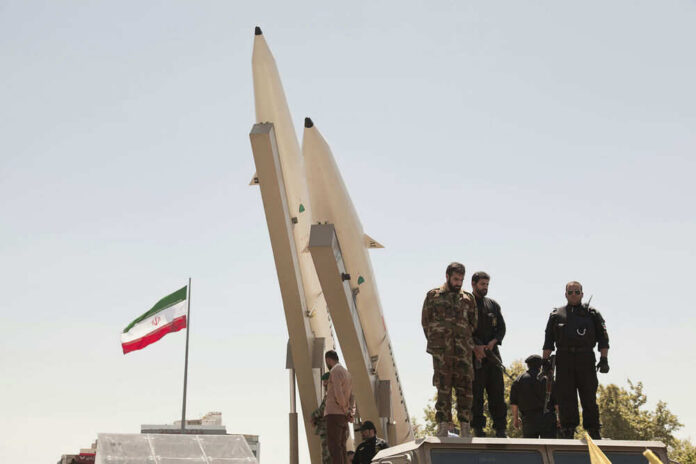
Iran entered the June 2025 conflict with a regional-scale ballistic missile inventory that U.S. Central Command previously assessed at roughly 3,000 missiles. After U.S. and Israeli strikes hit many missile facilities and launch infrastructure, several analyses still place Iran’s remaining stock around 1,500 missiles, with continued recovery into early 2026. The core issue for U.S. planners is not only inventory size, but Iran’s ability to regenerate capacity quickly.
Research summaries also emphasize that Iran’s arsenal is designed for asymmetric advantage: relatively cheaper missiles and drones aimed at exhausting expensive interceptors and forcing defenders to choose what to save. When Iran can fire large salvos, even strong defenses face hard limits in interceptor stocks, reload time, and coverage priorities. That “strategic math” matters for Israel’s homeland defense, and it matters for U.S. bases and ships across the region.
Underground “missile cities” and solid-fuel systems reduce warning time
Several assessments cite Iran’s use of underground storage and launch infrastructure—often described as “missile cities”—as a central reason the program survives airstrikes and sanctions pressure. Dispersal and concealment complicate targeting and battle-damage assessment, especially when facilities can be repaired or reconstituted out of sight. Solid-fuel missile families, highlighted in reporting, further compress decision time because they can be launched faster than liquid-fueled systems that require longer preparation.
Analysts point to families such as Fateh-110 and Kheibar Shekan as examples of solid-fuel systems that support rapid, repeated launches. They also highlight more advanced designs that reportedly incorporate maneuverable re-entry vehicle features, which can make interception more challenging at the margins. Even when defenses achieve high interception rates, the attacker can still seek mission kills by slipping a small percentage through, especially against fixed infrastructure targets.
Repairs to struck sites are measurable; true capacity remains partly uncertain
Multiple outlets and think-tank style analyses cite satellite imagery showing significant repair activity at missile-related locations struck during the 2025 war, with more than half of impacted sites reportedly restored to some level of function. Reporting also describes steps that can reduce visibility—such as roofing or concealment measures—making it harder to distinguish routine construction from military regeneration. This uncertainty is not a footnote; it shapes how much risk decision-makers must assume.
At the same time, several assessments acknowledge constraints that can cap real-world launch volume, including shortages in launchers, fueling logistics, and other enablers. Estimates for launchers and sustained sortie generation vary across sources, and the most aggressive claims about monthly production rates are not uniformly corroborated. That leaves a basic but important conclusion: Iran likely has enough missiles to threaten, but outside observers cannot precisely measure surge capacity until a crisis forces it into the open.
Defense upgrades help, but saturation risk remains the central concern
Reporting notes Israel has continued testing and upgrading layered defenses, including efforts aimed at higher-altitude intercepts and new technologies intended to cut per-shot costs. Those steps address the core problem defenders face: a limited number of expensive interceptors confronting a potentially large number of incoming threats. Even with high success rates, a prolonged exchange can turn into a resource battle, especially if the attacker accepts heavy losses to achieve a few high-impact strikes.
1,500 Missiles Ready: Iran’s Rebuilt Arsenal Is a ‘Threat’ to the U.S. Military and Israelhttps://t.co/HDcoxOHEHf
— 19FortyFive (@19_forty_five) February 25, 2026
For Americans, the practical takeaway is straightforward. A rebuilt Iranian missile force increases risk to U.S. personnel, bases, and partners, and it narrows the margin for error in any negotiation that treats missiles as a side issue. The research also shows why many conservatives remain skeptical of deals that focus narrowly on nuclear timelines while leaving delivery systems and regional coercion capacity intact. The arsenal is not theory; it is measurable, repairable, and designed to be used under pressure.
Sources:
https://www.jpost.com/middle-east/iran-news/article-885849
https://www.19fortyfive.com/2026/02/north-korea-has-a-fog-of-nuclear-war-problem/
https://jinsa.org/wp-content/uploads/2026/02/Irans-Evolving-Missile-and-Drone-Threat.pdf
https://www.fdd.org/in_the_news/faq/2026/02/25/iran-faq-what-you-should-know/
https://www.telegraph.co.uk/news/2026/02/20/the-carnage-iran-will-try-to-unleash-if-the-us-attacks/
Copyright 2026, PatriotNews.net