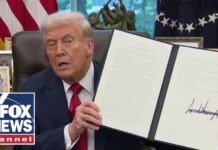

When major networks quietly pushed President Trump’s election-security speech off broadcast TV and onto low-traffic streaming feeds, it exposed how much power unelected media gatekeepers now have over what the public gets to see and hear.
Story Snapshot
- ABC, NBC and CNN declined to air President Trump’s primetime election-security address live on their main broadcast channels, instead moving it to streaming platforms.
- Trump and Rep. Buddy Carter accuse the networks of betraying the “public interest” and call for federal broadcasting licenses to be revoked or investigated.
- Legal and media experts say networks have wide editorial freedom and no clear duty to air non-emergency presidential speeches live.
- The clash feeds a growing belief on both left and right that powerful elites — in government and media — decide what information the public is allowed to see.
What Triggered the Fight Over Trump’s Primetime Address
On July 16, President Donald Trump delivered a primetime address from the White House focused on election security and alleged foreign interference in past U.S. elections. The White House asked major television networks to carry the speech live, treating it as a national address that should interrupt normal programming. CBS, Fox News Channel and the Fox broadcast network aired the remarks at least in part on their main channels. ABC, NBC and CNN instead chose to present the address on their digital streaming platforms and websites, not on their main broadcast networks. Their decision meant millions of viewers who still rely on traditional television had to search online to watch a sitting president speak about how votes are counted and protected.
ABC said it would stream Trump’s speech on ABC News Live and ABC News Radio with anchored coverage, and then cover key moments in regular newscasts. NBC likewise put live coverage on NBC News NOW, its free streaming service, and followed with a special report after the speech ended. CNN opted against live carriage on its main cable channel but streamed the event digitally. These networks argued that viewers could still watch the full address online and that their news divisions would fact-check and summarize any major claims afterward. Still, the move broke with long-standing habits in which most presidential primetime speeches automatically bump entertainment shows from the air. For many Americans, the optics were simple: the president asked to speak, and some of the biggest networks said “no” to live TV coverage.
Trump’s and Allies’ Demands to Punish the Networks
During the speech itself, President Trump blasted ABC and NBC by name, accusing them of refusing to air his remarks because “they know how corrupt our system is and they don’t want to reveal it.” He told viewers that “fraud like this should mean a revocation of their licenses,” arguing that the networks were part of a larger “plot” to hide election misdeeds from the public. Afterward, Trump repeated the demand, saying that any network that skipped his address on election security should lose its government-issued broadcast license. Representative Buddy Carter of Georgia backed Trump’s stance, urging federal regulators to investigate whether the networks had violated their duty to serve the public interest. Their argument plays directly into a broader frustration many Americans feel: that big media companies are no longer neutral referees but political actors who decide which stories count and which do not. For viewers already angry about “fake news” or elite spin, the idea of stripping licenses sounds like a way to finally hold these companies accountable.
Legal experts and media scholars push back hard on that idea. Under current law, broadcast licenses are issued and renewed by the Federal Communications Commission (FCC), but the First Amendment gives news outlets broad editorial freedom. There is no rule that forces ABC, NBC or any other broadcaster to air a non-emergency presidential speech live, even if the White House requests it. Past presidents from both parties — Barack Obama, Trump himself in earlier terms, and Joe Biden — have been turned down or only partially carried when they sought airtime for addresses viewed as mostly political. Revoking a license is an extreme step usually tied to technical violations or repeated failure to follow basic rules, not disagreement over programming choices. That means Trump’s threat is more political pressure than a realistic legal plan. Still, the fact that a sitting president and allies openly talk about using license power against critics alarms civil-liberties advocates, who see it as a sign of growing attempts to control the press.
Why Networks Say They Pulled Back — and Why Many Viewers Do Not Buy It
Network executives and media analysts say the choice to move Trump’s speech to streaming was about responsible coverage, not censorship. Trump’s address contained sweeping claims that China had illegally accessed millions of voter files in past elections and helped manipulate outcomes in 2018 and 2020. According to reporting on documents released by the White House, those materials did not back up his most dramatic accusations. Some editors feared that airing the event live on broadcast TV would spread unproven allegations to a huge audience in real time. They preferred to stream the speech for those who wanted to watch, then report on it with added context and fact-checking afterward. This approach grew out of earlier episodes, such as a 2020 speech where several networks cut away mid-stream, telling viewers the president was making false claims about a stolen election. From their side, the networks argue they are trying to balance the news value of presidential remarks with a duty not to mislead the public.
When President Trump requested a primetime address on election integrity, several major networks declined to air it live. Should they have? Michael argues that Americans deserve to hear a president's remarks firsthand—even when they're controversial—and explains why he believes… pic.twitter.com/9wQgPSI8FQ
— Michael Smerconish (@smerconish) July 20, 2026
For many Americans across the political spectrum, that explanation does not fully calm their worries. Conservatives see powerful media companies blocking a sitting president from speaking directly to the public on TV, reinforcing long-held fears that “coastal elites” filter information to protect their own political agendas. Liberals, who also distrust concentrated corporate power, worry that giant companies can decide which voices get a prime platform and which are shunted to smaller online spaces, with little transparency and no real democratic check. Both sides increasingly feel that gatekeepers in government, tech and media form a “deep state” of insiders who protect the status quo while ordinary citizens struggle with rising costs, unstable jobs and a fraying social contract. This latest episode fits that pattern: a key debate about elections and truth happened, but many people believe it was shaped as much by private boardrooms and political calculations as by any concern for the voters who still just want straight, honest information and a fair chance to pursue the American Dream.
Sources:
foxnews.com, reuters.com, usatoday.com, seattletimes.com, youtube.com, cnn.com, abc.net.au, washingtonpost.com, politico.com, san.com, ground.news, wsbtv.com, popular.info
© patriotnews.net 2026. All rights reserved.