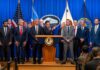

Trump’s “Big Beautiful Bill” quietly turned immigration enforcement into a $170+ billion mega-machine while cutting deep into health and safety nets many families rely on.
Story Snapshot
- The bill sends about $170–191 billion to homeland security and immigration enforcement, a historic expansion of federal power.
- Immigration detention and deportation systems get tens of billions, while courts, oversight, and due process rules lag far behind.
- To pay for this, the law helps drive trillions in new national debt and large cuts to Medicaid and nutrition programs.
- Both left and right see a “blank check” for elites and agencies, with little accountability to the public.
How the Bill Supercharged Immigration Enforcement
President Trump’s One Big Beautiful Bill Act, signed on July 4, 2025, funnels an estimated $170 to $191 billion into immigration and border enforcement over the rest of his presidency. This money mainly flows through the Department of Homeland Security, especially Immigration and Customs Enforcement and Customs and Border Protection. Nonpartisan budget analysts describe it as the largest expansion of immigration enforcement funding in U.S. history, locking in resources for years and shielding them from normal yearly budget fights.
The law sets aside about $45 billion just for new immigration detention centers, including facilities that hold families. Advocates say this will push detention capacity from tens of thousands of beds to numbers that rival the federal prison system. Another roughly $30–32 billion goes to deportation and enforcement operations, including hiring about 10,000 new immigration officers, paying for deportation flights, and upgrading vehicles and equipment. These moves aim to allow up to one million deportations per year, a scale the system has never handled before.
Border Walls, Surveillance, and a “Blank Check” Culture
Beyond detention and deportation, the bill devotes more than $75 billion to border militarization and surveillance. This includes about $46–47 billion for new border wall construction, far more than Trump’s first-term spending on barriers. Billions more fund additional Border Patrol agents, new checkpoints, advanced screening tools, and technologies like artificial intelligence and machine learning to track migrants and visa overstays. Civil rights and border community groups warn this will deepen a long-standing pattern of militarization in border regions that already feel under siege.
A key worry across the spectrum is how loosely some of this money is controlled. The law creates at least one $10–22 billion pot of “unspecified enforcement” funding that the Homeland Security Secretary can use for almost any border purpose, with little required reporting back to Congress. Legal analysts say there are few performance metrics, spending benchmarks, or transparency rules tied to this huge cash flow. For many Americans who already distrust the “deep state,” this looks less like security and more like a blank check for agencies that rarely face real consequences when they cross the line.
Debt, Health Care Cuts, and Shared Frustration
To fund this enforcement surge, the bill extends earlier tax cuts and adds new ones while also increasing military spending by more than $150 billion. Independent budget experts at the Congressional Budget Office estimate that, overall, the law increases federal debt by about $4.1 trillion through 2034 and by roughly $19 trillion over thirty years. At the same time, the bill cuts Medicaid by around $1 trillion and reduces nutrition aid programs by nearly $187 billion, hitting low- and middle-income families hardest.
Health policy critics point to a new rule that narrows who counts as “medically frail” for Medicaid protection, forcing very sick people to prove that illness directly keeps them from working. Forty-eight patient advocacy groups, including the American Cancer Society and Susan G. Komen, have publicly condemned these changes and urged they be rolled back. For many Americans, the picture is stark: billions more for detention centers and deportation flights, while health care and food support are cut for those already struggling in a high-cost economy.
Why Both Left and Right See a Failing System
Democratic lawmakers and immigrant-rights organizations attack the Big Beautiful Bill as a partisan, anti-immigrant project that trades community stability for mass detention. They argue it strips many lawfully present immigrants of access to health insurance, nutrition aid, and child tax benefits, while giving immigration agencies unprecedented power with minimal safeguards. They say this shifts the American dream further out of reach for mixed-status families who work hard but now face greater risk of arrest, detention, or loss of benefits.
ENOUGH IS ENOUGH!
Who's ready for Scott Fitzgerald to retire?
He voted for the so-called Big Beautiful Bill. He voted for the SAVE America Act.
He voted to give billions more for DHS and Immigration Enforcement while Americans struggle with the rising cost of healthcare,… pic.twitter.com/uvNQKnrbZA
— Beck for Congress (@beck_congress) June 28, 2026
Many conservatives, meanwhile, cheer stronger border enforcement but question the cost and lack of oversight. Fiscal hawks point to the multi-trillion-dollar debt impact and see another example of Washington spending big now while leaving the bill to future generations. Others worry that concentrating so much unchecked power in federal agencies runs against core American ideals of limited government and local control. On both sides, the pattern feels familiar: elites in Washington use a giant, complex bill to expand their reach, while ordinary people—citizen and immigrant alike—are left to bear the costs in debt, taxes, and daily fear.
Sources:
reason.com, fwd.us, facebook.com, nilc.org, crfb.org, taxpolicycenter.org, budgetlab.yale.edu, bipartisanpolicy.org, pgpf.org, cbo.gov
© patriotnews.net 2026. All rights reserved.











![🇺🇸 President Trump Delivers Remarks at Faith & Freedom Coalition Conference in Washington, DC [LIVE]](https://patriotnews.net/wp-content/uploads/sites/6/2026/06/maxresdefault-75-100x70.jpg "Religious Liberty ‘Under Siege,’ Trump Warns")