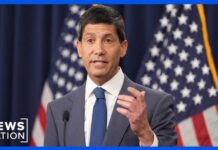
Four days before Michigan’s election, Democratic Senate candidate Abdul El-Sayed told his own primary rival to stay away from his campaign events.
Story Snapshot
- Rep. Haley Stevens said she would only appear alongside El-Sayed if he condemned an outside ad and apologized for past Israel remarks.
- The disputed ad, from Rebellion PAC, showed a grocery-store scene blaming high food prices on money spent “killing Palestinians.”
- El-Sayed’s campaign said it was not involved with the ad and said defeating Republican Mike Rogers was the real priority.
- A planned unity event in Detroit, meant to include Rep. Jim Clyburn, turned into a public standoff over who would show up.
A Rare Appearance Turns Into A Standoff
Stevens and El-Sayed fought a bitter Democratic primary this past summer, and El-Sayed won. Party leaders hoped a joint appearance before Election Day would show Michigan Democrats were united behind him. Instead, the plan fell apart in public view, with Stevens setting conditions and El-Sayed’s campaign later telling her to skip his remaining events, according to multiple reports.
Stevens said on October 30 that she agreed to appear with El-Sayed only after being told he planned to condemn the outside ad. She wrote that the ad told Michigan families they could not afford groceries because money had to go toward “killing Palestinians,” and she said El-Sayed needed to speak out against it directly.
What The Ad Actually Said
PolitiFact reviewed the digital ad and confirmed its content. It featured a grocery-store dialogue about setting aside seven dollars for “killing Palestinians,” closed with the line “Abdul El-Sayed is for you,” and used imagery of Israeli Prime Minister Benjamin Netanyahu. Stevens argued the ad did not invent its message out of nowhere. She said it dramatized arguments she believes El-Sayed made during the campaign about Israel driving up costs for schools, health care, and child care.
Reports describe Rebellion PAC as an outside progressive group with no formal tie to El-Sayed’s campaign. His team has publicly distanced itself from the ad. Some Jewish groups, including the Anti-Defamation League, called it an example of antisemitic messaging, though that label has not been settled by any independent review process described in current reporting.
El-Sayed Pushes Back, Points To Rogers
El-Sayed responded on social media the same night. He said his campaign was focused on beating Rogers and lowering prices for Michigan families, adding that “this should be the priority for all of us right now.” His statement did not include an apology for his Israel remarks or a direct condemnation of the ad’s specific wording, based on available reporting.
In earlier debates against Rogers, El-Sayed linked his foreign policy views to pocketbook issues. He argued that U.S. involvement in Middle East conflicts, which he said Rogers had cheered, drove up gas and grocery prices for ordinary families. He also denied accusations tying him to groups hostile to Israel, calling such claims false during televised debate exchanges.
A Church Event With Limited Access
The unity appearance was set for a Black church in Detroit, with Clyburn also scheduled to attend. Michigan Advance reported the event was not expected to be widely open to the public or press, meaning few outside observers would be able to confirm whether the two campaigns actually reconciled. That limited access raises the odds that competing public statements, rather than the event itself, will shape how voters understand the dispute.
Why This Matters Beyond Michigan
Negative political ads rarely change many minds on their own. A review of 146 advertising experiments from 2018 and 2020 found their persuasive effects were measurable but usually small. Their real power often comes from forcing rivals to respond publicly, generating news coverage, and testing party loyalty, exactly what has unfolded in Michigan this week, regardless of how many voters accept the ad’s underlying claim.
For voters on both sides of the aisle already skeptical of party leadership, this episode offers a familiar storyline. A high-stakes Senate race, meant to showcase unity against a shared Republican opponent, instead exposed open conflict over Israel, outside spending, and who speaks for the party. Whether the rift heals before Election Day or simply gets papered over will likely shape how Michigan Democrats head into the final vote.
🚨 NOW: Michigan Democrat Campaign Event COLLAPSES Over Antisemitic Ad Dispute
A planned joint campaign appearance between Senate candidate Abdul El-Sayed and Rep. Haley Stevens collapsed after his team told her to stay away following an anti-Israel PAC ad dispute.
The modern…
— Bobby (@bobbymorris280) October 31, 2026
Both campaigns have incentive to project unity publicly while privately disagreeing on what accountability looks like. The dispute leaves unresolved questions about whether El-Sayed will take further steps to address Stevens’s concerns, and whether Stevens will ultimately appear at the Detroit event at all.
Sources:
michiganpublic.org, cnn.com, fortune.com, yahoo.com, clevelandjewishnews.com, nbcnews.com
© patriotnews.net 2026. All rights reserved.