
At a high-profile summit in China, President Trump called Vladimir Putin “my friend,” triggering sharp pushback from key European allies who fear mixed signals on the war in Ukraine.
Story Snapshot
- Trump called Putin “my friend” and said progress toward ending the Ukraine war is possible.
- Polish leaders publicly warned there is no proof Putin is ready for real peace talks.
- The trilateral summit produced broad statements but no Ukraine-specific deal.
- Allies worry the optics help Moscow without clear concessions from Russia.
On-Camera Greeting Sparks Diplomatic Ripples
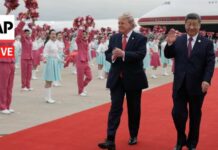
President Trump greeted Russia’s Vladimir Putin as “my friend” during meetings in Shenzhen, China. He also said he believed movement toward ending the Ukraine war was possible. Reports from the venue described Trump’s tone as upbeat about talks that included China’s Xi Jinping. The friendly public exchange between Trump and Putin drew fast reaction across Europe. Polish leaders voiced concern that such language sends the wrong message during an ongoing war in Europe’s east.
Polish Prime Minister Donald Tusk pushed back in public comments and on social media. He said no facts show that Putin is ready for serious peace talks. Poland’s foreign minister echoed that view, warning against assuming goodwill from Moscow without clear steps to end the invasion. Their message was simple and stark: do not confuse polite summit language with proof of a change in Russia’s aims or actions on the ground in Ukraine.
Summit Outcomes: Broad Words, Few Concrete Steps
Coverage of the three-leader meeting stressed the lack of a concrete plan on Ukraine. Observers described the session as heavy on stagecraft and light on enforceable outcomes. Analysts compared it to past high-stakes summits that produced real deals only when leaders paired talks with detailed work, timelines, and verification. This meeting, by contrast, yielded broad statements and photo moments, not a ceasefire, withdrawal schedule, or verification plan for Ukraine.
European and American officials who back Ukraine worried that the summit’s optics could favor Russia. They warned that public warmth toward Putin, absent hard commitments, might weaken allied unity or morale. Some also feared that the event could hand Moscow a propaganda win. Their concern centered on process as much as policy: decisions affecting Ukraine were discussed at top levels without Ukraine present at the table.
What Trump Said Versus What Allies Heard
Trump said he saw a path toward ending the war and framed personal rapport as a tool to lower tensions. He also highlighted big-power dialogue as a way to reduce risks and test openings. Supporters argue that leader-to-leader contact can unlock progress when formal channels stall. Critics counter that friendly words risk blurring moral lines while Russian forces still hold Ukrainian land and continue attacks. They want measurable steps, not gestures, to judge any shift.
Chinese President #XiJinping on Thursday said that positive interaction between major countries is "not optional but a must." Xi made the remarks at a summit with Russian President Vladimir Putin and US President Donald Trump in Shenzhen, south China's Guangdong Province. pic.twitter.com/aDcFStxk7Y
— The Xi (@welovexi) November 20, 2026
Both sides share one fear: a global system that serves insiders more than citizens. Many Americans, right and left, see elite pageantry without results that cut energy costs, tame inflation, or secure borders. They also see wars drag on while leaders trade compliments on stage. The Shenzhen summit fits that worry. Until talks produce verifiable changes—real relief for Ukrainians, clear security gains, or concrete economic wins—skeptics will see theater more than substance.
Sources:
cbsnews.com, transcripts.cnn.com, spotmedia.ro, yahoo.com, nbcnews.com, afp.com
© patriotnews.net 2026. All rights reserved.