
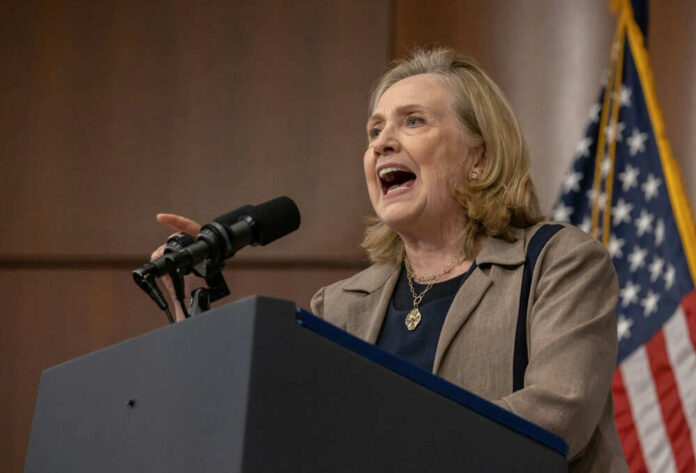
(PatriotNews.net) – America’s most famous champion of “free speech” accused her rival of authoritarianism on national TV, less than 24 hours after her own party was exposed for pressuring Big Tech to muzzle Americans.
Story Snapshot
- Hillary Clinton blasted Donald Trump as a threat to free speech on MSNBC.
- Google admitted to Congress it censored Americans at the Biden administration’s request.
- The timing spotlights accusations of hypocrisy and selective outrage in Washington’s free speech debate.
- Congressional investigations, media drama, and Big Tech’s gatekeeping fuel public distrust.
Clinton’s Accusation Lands During a Firestorm
Hillary Clinton’s September 24 appearance on MSNBC’s “Morning Joe” wasn’t just another round of campaign talking points. The nation was still reeling from Google’s bombshell admission the previous day: YouTube had removed legal American speech under pressure from Biden administration officials. Clinton used her airtime to denounce Donald Trump as “dangerous” to the First Amendment, claiming he weaponized “the authoritarian playbook” by attempting to silence critics and the press, even referencing ABC’s suspension of Jimmy Kimmel. The spectacle wasn’t lost on viewers already questioning who really holds the levers of censorship in modern America.
Clinton’s words echoed across political media as analysts and citizens drew sharp lines between her warnings and the mounting evidence of Big Tech-government collusion. For many, her timing appeared less like a principled stand and more like a calculated move to flip the script, just as Democratic influence over tech moderation was thrust into the spotlight.
The Google Admission: Censorship Confirmed
September 23, 2025, proved pivotal for the growing debate on free speech. Google, under oath before the House Judiciary Committee, admitted YouTube had suppressed content at the request of the Biden administration, content that broke no platform rules and was legal under the Constitution. This confession came after years of denials and obfuscation from tech giants and their political patrons, reigniting bipartisan outrage and fueling demands for accountability from both the left and right. The House Judiciary, led by Chair Jim Jordan, pounced on the evidence as proof of government overreach into the digital public square.
The juxtaposition was as sharp as it was uncomfortable: Clinton’s warning of Trump’s “dangerous” authoritarianism came as her own party’s fingerprints were fresh on the tools of suppression. Critics quickly pointed to the irony, Democrats, long self-styled as defenders of free expression, now exposed for orchestrating the very censorship they decried when wielded against them.
Media, Tech, and Political Power Struggles Explode
The Clinton-Google double punch amplified a much older struggle over who decides what Americans can say, read, and hear. Since the rise of social media, tech companies have become the new gatekeepers of public discourse. Both parties have accused each other of leveraging these platforms to silence dissent: Republicans cite the “Twitter Files” and COVID-era takedowns as proof of a left-wing censorship machine; Democrats warn of Trump’s threats to the press and efforts to punish media critics. The recent Google admission, however, shifted the balance. For once, a Silicon Valley titan admitted, in plain language, that legal American speech had been erased at government direction.
Media organizations like ABC, meanwhile, find themselves caught between corporate, political, and cultural crosswinds. The Kimmel suspension, referenced by Clinton as evidence of Trump’s supposed authoritarian leanings, was a corporate decision. No evidence has surfaced showing Trump orchestrated the move. This blurring of lines between government, tech, and media leaves the public more skeptical than ever of official narratives.
Long-Term Ramifications and the Battle for Free Speech
The fallout from this week’s revelations will ripple through Congress, the courts, and Silicon Valley for years. Tech companies now face increased scrutiny and the prospect of legislative action to safeguard digital speech from government interference. Content creators and ordinary users, already wary of arbitrary bans, may self-censor or abandon platforms they perceive as untrustworthy. Political polarization only deepens, as both sides accuse the other of hypocrisy, Democrats for government-instigated censorship, Republicans for alleged attacks on the “free press.”
Legal scholars warn that government pressure on private companies to suppress speech treads dangerously close to violating the First Amendment. Media analysts and industry watchdogs highlight the risks of selective outrage, noting that partisan framing not only clouds the real issues but also undermines public confidence in institutions. The only certainty: the fight over who controls speech in the digital age is just beginning, and no one, politician, tech executive, or journalist, will escape unscathed.
Copyright 2025, PatriotNews.net




![🇺🇸 President Trump Delivers Remarks at Faith & Freedom Coalition Conference in Washington, DC [LIVE]](https://patriotnews.net/wp-content/uploads/sites/6/2026/06/maxresdefault-75-100x70.jpg "Religious Liberty ‘Under Siege,’ Trump Warns")