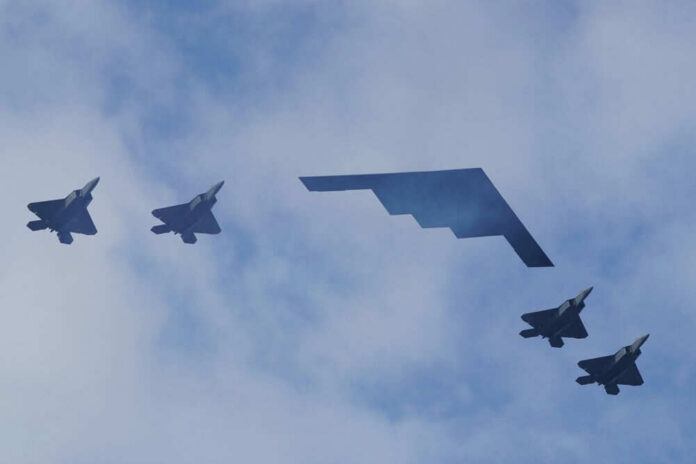
(PatriotNews.net) – After years of “do more with less” thinking, the Air Force is betting that a hard-nosed F-22 upgrade push in 2026 can restore American air dominance without waiting on an all-new jet.
Story Snapshot
- The Air Force and Lockheed Martin are advancing a package of F-22 upgrades—range, sensors, weapons, and electronic warfare—to keep the Raptor viable into the mid-2030s.
- Low-observable external fuel tanks are moving toward certification with planned squadron deliveries starting in March 2026, addressing a long-standing Indo-Pacific range problem.
- Infrared Search and Track (IRST) testing and infrared sensor work aim to boost passive detection against advanced threats while preserving stealth advantages.
- Reports describe the “Super Raptor” label as more branding than a single revolutionary leap, with many improvements arriving as incremental, budget-driven upgrades.
What the “Super Raptor” Actually Means in 2026
Lockheed Martin and the U.S. Air Force are treating 2026 as a pivotal year for the F-22’s modernization arc, not by reinventing the fighter from scratch, but by stacking practical upgrades that expand combat relevance. Public reporting points to ongoing reliability and sustainment work alongside targeted capability additions—better sensors, improved electronic warfare, and extended range. The strategy is to keep 143 combat-coded Raptors credible against top-tier competitors while next-generation programs mature.
That framing matters because the F-22 has been the country’s premier air-superiority tool since entering service in 2005, yet the fleet is small and aging. With only 185 total aircraft built and production ending in 2011, the Air Force has had to stretch a limited inventory across a changing threat landscape. The budget-driven reality is straightforward: upgrading a proven stealth fighter is faster than rebuilding the industrial base to restart F-22 production from scratch.
Stealthy Fuel Tanks: Fixing Range Without Giving Up Low Observability
The most concrete “Raptor 2.0” change highlighted across reporting is the move toward low-observable external fuel tanks and associated pylons—designed to extend range while maintaining stealth characteristics. Testing milestones cited include wind tunnel work, ground testing, and planning completed in 2023, with additional progress through 2024. The planned next step is certification and initial squadron deliveries beginning in March 2026, pending completion of required testing and approval.
Range is not a cosmetic problem; it shapes where and how the F-22 can fight. Earlier non-stealthy tanks created an operational tradeoff: carry more fuel but risk compromising low-observable advantages when it matters most. The low-observable tank approach aims to reduce that dilemma, especially for Pacific distances where refueling and basing options can be contested. If these tanks deliver as planned, the Air Force gains more flexibility to position Raptors where deterrence requires them.
IRST and Infrared Sensors: Seeing Targets Without Broadcasting Your Position
Another major pillar is infrared capability—often summarized as IRST and related sensor systems—intended to help pilots detect and track threats passively. Public accounts describe IRST pods being flight tested in 2024 and sensor maturation continuing as part of the broader modernization effort. This matters in a world where adversaries invest in radar warning and electronic attack; passive tracking can help preserve the F-22’s ability to find and engage targets while limiting its own electronic signature.
These upgrades also underline a less-advertised truth: some capabilities were left off the original F-22 configuration due to cost and program priorities in the 1990s. The current approach looks like a retrofit campaign to close those gaps, supported by reported contracting and budgeting steps for infrared-related improvements. The net effect is not a “sixth-generation” transformation, but a practical attempt to keep a fifth-generation platform ahead of evolving detection and counter-stealth techniques.
Weapons, Software, and Electronic Warfare: Incremental Gains With Real Consequences
Modernization is also tied to software and weapons integration. Reporting cites the completion of the Increment 3.2B software upgrade across the combat-coded fleet, improving missile employment and other functions. Separate coverage points to AIM-260 Joint Advanced Tactical Missile testing progress during 2025, along with a FY2026 “viability” package that includes funding for electronic warfare, stealth-related improvements, and helmet display work. Taken together, those pieces reflect a steady push to extend lethality and survivability.
The caution for readers is the same one found in serious aviation coverage: “Super Raptor” headlines can outrun confirmed details. Available information supports the idea of layered improvements—some already fielded, some tested, and some budgeted—rather than a single dramatic leap. That distinction matters for accountability. A credible modernization plan is measured by funded programs, testing milestones, and fielded capability, not marketing labels or political talking points.
Why This Upgrade Push Resonates Beyond the Flight Line
For Americans tired of watching Washington drift into expensive distractions and endless “messaging” instead of results, the F-22 story is a reminder that deterrence is built on capability, readiness, and realism. Reporting notes the F-22 mission-capable rate fell to a 20-year low in FY2024, a signal that sustainment cannot be treated as an afterthought. The 2026 upgrade push is ultimately about restoring readiness while adding the range and sensors needed for modern, high-end threats.
The F-22 “Super” Raptor: Why the World’s Stealthiest Jet is Getting a 2026 Rebirth by @BMEastwood https://t.co/M0TPdtAuSe
— 19FortyFive (@19_forty_five) February 25, 2026
None of this guarantees perfection, and the publicly available record leaves some uncertainties—such as precise timelines for full integration of every planned system and how quickly readiness metrics can recover. Still, the direction is clear: preserve U.S. air superiority by upgrading what works, fielding improvements that are test-backed, and bridging to future aircraft without creating a dangerous capability gap. In an era of serious competitors, that pragmatic approach is hard to argue with.
Sources:
Lockheed Martin’s F-22 Raptor model features low observable fuel tanks and infrared sensor pods
The F-22 “Super” Raptor: Why the World’s Stealthiest Jet is Getting a 2026 Rebirth
Upgraded F-22 Raptor “2.0” Details Seen In New Model
Copyright 2026, PatriotNews.net