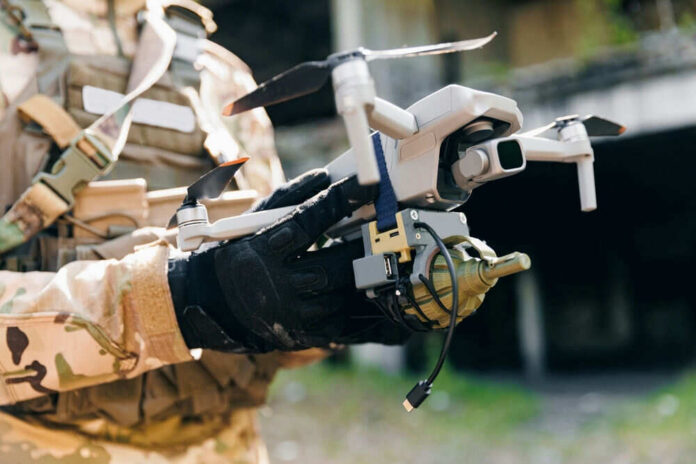
(PatriotNews.net) – A Ukrainian robotics CEO is selling a future where a single soldier, backed by artificial intelligence, commands vast swarms of drones—raising serious questions about who controls this technology and how it will be used against American interests and values.
Story Highlights
- Ukrainian firm Ark Robotics claims future wars will be fought by one soldier directing huge AI-driven drone swarms.
- NATO allies like France and Sweden are racing to field autonomous swarms and one-operator-many-drone systems.
- AI-driven swarms risk concentrating deadly power in fewer hands and blurring human control over lethal decisions.
- Trump’s America must ensure swarm tech strengthens U.S. security and sovereignty, not globalist war experiments.
Ukrainian CEO’s Vision: One Soldier, Thousands of Drones
A Business Insider report profiles Ark Robotics, a Ukrainian company whose autonomous ground robots already serve in more than twenty brigades, and whose CEO argues that future warfare will depend on one operator controlling large swarms of aerial and ground drones through artificial intelligence. The company is building a unified control layer designed to coordinate thousands of machines from multiple manufacturers with minimal human input, turning drones from individual tools into a tightly choreographed robotic army directed by a single soldier.
The CEO warns that simply owning “fancy drones” means little if militaries cannot deploy them at scale, so Ark focuses on autonomy and collaboration rather than just hardware numbers. Ukraine’s brutal war with Russia provides real-world testing for these concepts, with the country using drones to offset manpower disadvantages. The battlefield has become a proving ground for ideas that many Western planners expect to spread into NATO doctrine, reshaping how future conflicts are fought far beyond Eastern Europe.
From One-Operator-Per-Drone To One-Operator-Per-Swarm
For decades, militaries treated unmanned aircraft as scarce, high-end assets, often dedicating one operator or even entire crews to each drone. That model collapses once hundreds of inexpensive quadcopters and ground robots launch simultaneously across contested terrain. Recent advances in artificial intelligence now promise “one operator per swarm,” enabling software to manage route planning, obstacle avoidance, formation changes, and target assignment while humans supervise overall intent. This shift dramatically increases combat mass without matching increases in personnel.
The Russia–Ukraine war, the most drone-saturated conflict in history, has accelerated this change. Both sides routinely employ reconnaissance quadcopters, kamikaze first-person-view drones, and loitering munitions, with small multi-drone teams already coordinating strikes. NATO states and U.S. rivals alike watched these experiments and began supercharging research into swarming tactics, automation, and countermeasures. Patent data show more than half of swarm-control innovations emerging in just a few recent years, underscoring how quickly the technology is maturing and spreading among major powers.
NATO Allies Push Swarm Programs While America Builds Defenses
European allies are openly embracing swarm warfare. France’s Pendragon project aims to field mixed land–air robotic combat units by around 2027, guided by artificial intelligence that keeps formations intact even when a lead drone is destroyed. Swedish leaders, studying Ukraine’s experience, now seek systems allowing one soldier to autonomously control up to one hundred drones. These programs treat swarms as maneuver units, not accessories, meant to punch through fortified lines and overwhelm enemy defenses with cheap, numerous platforms.
The United States, under renewed America First leadership, is investing heavily in counter-swarm capabilities to shield troops and homeland assets. The Navy is soliciting artificial-intelligence tools that can automatically recognize and track multiple drones or small vessels at once from helicopters, ensuring human operators are not overwhelmed. Major defense firms are marketing integrated counter–unmanned-air-systems architectures that fuse radar, electro-optical, infrared, and radio-frequency sensors to classify threats and cue jamming or kinetic responses. This focus reflects a conservative priority: protecting American lives and territory before chasing futuristic offensive experiments.
Constitutional, Ethical, And Strategic Risks Of AI-Led Warfare
As autonomy expands, the line between human-supervised and machine-driven lethal decisions grows blurry, raising concerns for Americans who value constitutional checks on government power and strict civilian control of the military. When one soldier commands a thousand semi-autonomous weapons, the potential for malfunction, spoofing, or abuse increases, especially if globalist institutions push looser rules abroad that later bleed into U.S. doctrine. Ethical debates over lethal autonomous weapons will intensify as swarms approach genuine battlefield independence.
Robotics industry insider says the future is one soldier backed by AI controlling swarms of drones: https://t.co/KioMUJCrZ4
— Randy Kemp (@randylewiskemp) December 10, 2025
Strategically, cheap swarms risk empowering hostile regimes and non-state actors, making it easier to overwhelm defenses or stage surprise attacks at scale. That reality underscores why a Trump-era focus on border security, strong deterrence, and energy and industrial independence matters. If future wars can be launched by small teams wielding mass-produced robotic arsenals, America cannot afford bureaucratic complacency, politicized militaries, or overseas entanglements that ignore core national interests and the safety of American families at home.
Copyright 2025, PatriotNews.net