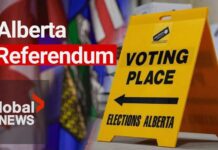

Alberta voters shut down a formal path to independence by roughly three to one, yet a quarter still backed starting the legal process to leave Canada.
Story Snapshot
- About 76% voted to remain in Canada; 24% supported beginning a legal path to a binding separation vote.
- The ballot asked whether to stay or to start the constitutional process; it did not trigger separation.
- Premier Danielle Smith urged unity and said Alberta can gain more autonomy within Canada.
- Rural areas showed stronger separatist support than major cities, pointing to a lasting constituency.
What Albertans Decided And What The Question Actually Said
Election results showed a clear choice: stay in Canada now, not launch a separation process. Reuters reported about 76% for remaining and 24% for beginning the legal steps toward a binding referendum. The ballot language mattered. It asked whether Alberta should remain a province or whether the government should start the process required under the Canadian Constitution for a later, binding vote. The question itself did not separate Alberta or set any terms for independence.
This design kept the focus on process, not an immediate break. That kept legal guardrails in place, including Canada’s “clarity” rules for any secession effort. Those rules, rooted in the Supreme Court of Canada and the Clarity Act, say a clear question and a clear majority are needed before talks on secession would begin, and even then, leaving is not automatic. Alberta’s vote fell well short of that threshold and signaled unity, at least for now.
Why A Quarter Still Voted To Start The Separation Process
Many Albertans say federal rules on energy, exports, and the environment have hurt jobs and investment. Backers of a legal path to separation argue Ottawa ignores the province’s core industry and values. Rural ridings showed higher support for the process than big cities, which aligns with a political base that feels sidelined by national leaders and media. These voters used the ballot to register anger and to try to force a debate with real legal weight attached.
But the referendum did not prove those policies caused specific economic harms. It did not measure net federal dollars in or out or decide critical terms like borders, debt, currency, or Indigenous treaty duties. Those would all be major hurdles later. The outcome leaves a minority that is organized and motivated, yet without a direct mandate for independence. That tension will keep pressure on both Edmonton and Ottawa to show results on energy, trade, and provincial powers.
How Leaders Framed The Path Forward Inside Canada
Premier Danielle Smith said she would vote to remain and argued Alberta can protect its autonomy better inside a decentralized Canada. She urged changes to federal rules that, in her view, interfere with provincial control over resources. She also said Alberta can grow oil and gas output and exports within Canada, not only outside it. She framed the result as “a stronger Alberta in a united Canada,” signaling she heard voter anger but prefers reform over a break.
National leaders highlighted partnership to cool tensions. Reporting described calls for cooperation on pipelines, water, housing, and defense as proof that the federation can still work when both sides engage. The message is simple: deliver concrete projects and jobs, and the separatist impulse may ebb. If talks stall and projects die on the vine, frustration could return fast, and the minority that voted to start the separation process may grow.
What This Means For Canadians Worried About Distant Elites
Voters sent two messages at once. First, they do not want a leap into the unknown without clear terms. Second, they are tired of decisions that feel made far away, with costs borne at home. The large “remain” vote avoids chaos today, but the 24% signals a trust gap between many Albertans and federal power. Bridging that gap takes transparency on energy rules, fair treatment on transfers, and respect for provincial jurisdiction, not slogans.
One clear message from the referendum: Alberta separatists should go back to their separatist micro parties, rather than trying to destabilize Alberta by infiltrating a party created and elected to support national unity.
Reminder:
👉The last time a separatist party contested… https://t.co/lViCXOq0ZI
— Jason Kenney 🇨🇦🇺🇦🇮🇱 (@jkenney) October 20, 2026
For readers across the spectrum, the takeaway is familiar: when leaders deliver on basics like paychecks, permits, and pipes, unity holds. When process drags and promises slip, anger spreads, and movements on the edge gain oxygen. Alberta’s choice pauses a breakup drama. It does not end the deeper fight over who decides, who pays, and who benefits. The next phase will test whether Canada’s institutions can act faster than people’s patience runs out.
Sources:
youtube.com, abc.net.au, alberta.ca, thehub.ca, thecanadianpressnews.ca
© patriotnews.net 2026. All rights reserved.