

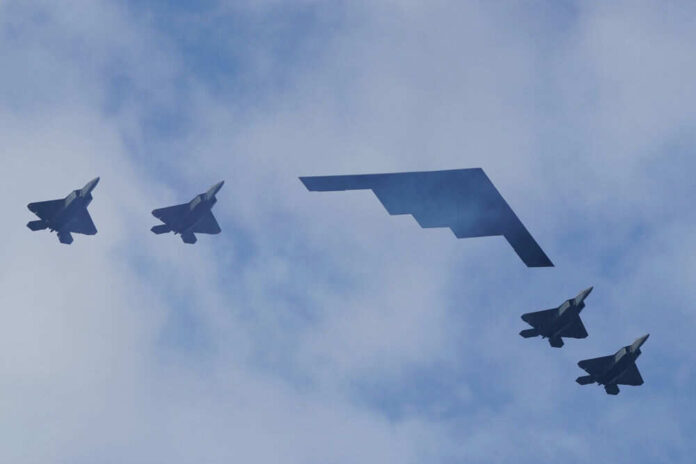
(PatriotNews.net) – Russia’s most advanced operational fighter jet relies on World War II-era dogfighting principles in an age where invisibility to radar determines who lives and who dies.
Story Snapshot
- Su-35 Flanker excels in maneuverability with thrust-vectoring engines but lacks stealth technology
- Russia delivered seventh batch in 2025 despite Western sanctions limiting production components
- Ukraine conflict exposes vulnerabilities as Su-35s suffer heavy losses against stealth-equipped forces
- Aircraft bridges gap to Russia’s troubled Su-57 stealth program while maintaining export relevance
The Dogfighter in a Stealth World
The Su-35 Flanker represents Russia’s commitment to an increasingly obsolete philosophy of aerial combat. While American F-22 Raptors and F-35 Lightning IIs slip through enemy radar like ghosts, the Su-35 announces its presence from hundreds of miles away. This 4.5-generation fighter prioritizes raw performance over survivability, featuring AL-41F1S engines that generate 142.2kN of thrust each and enable jaw-dropping post-stall maneuvers that would make Top Gun pilots weep with envy.
Sukhoi’s engineers equipped the Flanker with three-dimensional thrust vectoring, allowing pilots to execute 9-g turns and maintain control even when the aircraft should theoretically fall from the sky. The jet achieves supercruise speeds exceeding Mach 1.1 without afterburners and reaches a maximum velocity of Mach 2.25. These capabilities make it formidable in close-range combat scenarios where stealth advantages disappear and pilot skill determines outcomes.
Sensors That See Through Stealth Claims
The Su-35’s Irbis-E passive electronically scanned array radar represents a serious attempt to counter Western stealth technology. This system detects targets with radar cross-sections as small as 0.01 square meters at ranges up to 90 kilometers, theoretically capable of spotting F-35s under certain conditions. The aircraft also features an OLS-35 infrared search and track system that passively acquires targets between 50-90 kilometers without revealing the Su-35’s position through radar emissions.
Pilots can simultaneously track 30 targets and engage eight with the aircraft’s arsenal of R-77 beyond-visual-range missiles, R-73 short-range interceptors, and various air-to-ground munitions distributed across 14 hardpoints. The jet carries up to 8,000 kilograms of ordnance, making it equally capable against aerial threats and ground targets. However, external weapons dramatically increase the aircraft’s already substantial radar signature, negating any hope of approaching undetected.
Reality Check Over Ukraine
The harsh realities of modern warfare have exposed the Su-35’s fundamental weakness through brutal experience over Ukrainian airspace. Multiple aircraft have been lost to surface-to-air missiles and enemy fighters, with military analysts noting they are “dropping like flies” in contested environments. The jet’s large radar cross-section makes it visible to modern air defense systems from extreme ranges, eliminating the element of surprise that proves crucial in contemporary air combat.
Despite these losses, Russia continues production with United Aircraft Corporation delivering the seventh batch of Su-35S fighters in 2025. This persistence under Western sanctions demonstrates Moscow’s commitment to maintaining aerial capabilities, even as component shortages and technological isolation strain the defense industrial base. The aircraft remains operational with approximately 150 units serving Russian forces while exports to countries like China provide essential revenue streams.
Sources:
Airforce Technology – Su-35 Project Profile
Military Factory – Su-35 Aircraft Details
19FortyFive – Su-35 Flanker Analysis
Army Recognition – Su-35 Flanker-E Profile
National Interest – Su-35 Ukraine Operations
Defence Security Asia – Su-35S Seventh Batch Delivery
Copyright 2026, PatriotNews.net