

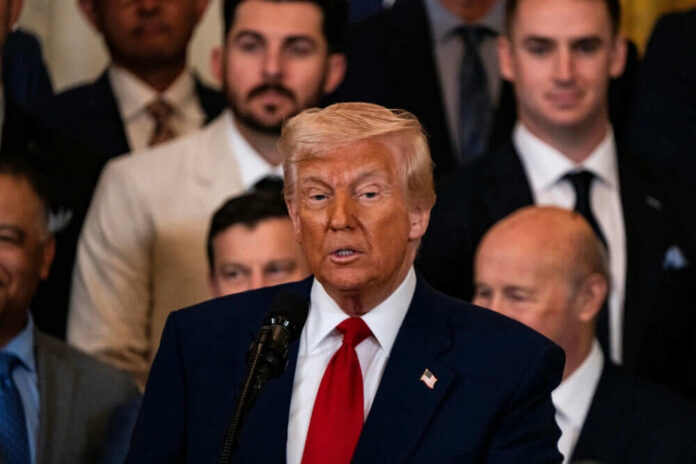
(PatriotNews.net) – President Trump just refused to make Washington’s favorite promise—“no boots on the ground”—as U.S. forces trade strikes with Iran and Americans are already dying.
Quick Take
- Trump told the New York Post he would not rule out ground troops in Iran “if necessary,” breaking from the scripted denials past presidents often used.
- The comment came on March 2, 2026, during day three of joint U.S.-Israeli operations against Iran, after diplomacy collapsed.
- Iran has hit back with missiles and drones across the region, including strikes targeting U.S. bases and partners, contributing to widening instability.
- U.S. casualty reporting is evolving across outlets, with multiple reports confirming American deaths and serious injuries.
- The IAEA warns it cannot confirm damage to nuclear installations and raises alarms about nuclear safety risks and a lack of contact with Iranian regulators.
Trump Keeps Ground Options Open as the Air Campaign Expands
President Donald Trump said he would consider deploying U.S. ground troops to Iran “if they were necessary,” rejecting the usual political language meant to calm voters while wars grow anyway. Trump told the New York Post he doesn’t have the “yips” about boots on the ground and won’t pretend they are off the table. The statement landed as U.S. and Israeli strikes continued into a third day, with Trump signaling harder hits may still be ahead.
Joint operations—described in reports as “Operation Roaring Lion”—began Saturday after last-minute diplomacy fell apart. Israeli officials have described a high-volume strike campaign, including attacks on missile infrastructure, air defenses, leadership-linked targets, and nuclear-related sites. Trump has said the operation will continue until objectives are achieved and suggested a timeline of “four weeks or less,” while also acknowledging more U.S. casualties are possible as Iran keeps firing back.
Retaliation Spreads Across the Region, Pulling Allies Into the Line of Fire
Iran’s retaliatory strikes have included missiles and drones aimed at U.S. positions and regional partners, with reports of cruise missiles used against U.S. air bases in Kuwait and vessels in the Indian Ocean. Several countries have shut or restricted airspace, reflecting how quickly this conflict can disrupt everyday travel and commerce. A friendly-fire incident was also reported in Kuwait involving three U.S. F-15E Strike Eagles; all crew members reportedly ejected and were recovered.
Casualty figures remain fluid, but multiple reports confirm American service members have been killed and others seriously wounded. The same coverage indicates casualties in Israel from Iranian strikes and significant reported deaths inside Iran. For U.S. families watching at home, the evolving numbers underscore a harsh reality: once a shooting war is underway, the fog of war doesn’t just cloud battlefield facts—it also tests public trust when counts change by the hour and politics competes with clarity.
IAEA Warns of Nuclear Safety Risks and a Dangerous Information Gap
The International Atomic Energy Agency has added a sobering warning: it has reported no indication, so far, that Iranian nuclear installations have been damaged, while also flagging “very concerning” safety risks. IAEA Director General Rafael Grossi warned a radiological release cannot be ruled out and said the agency has been unable to contact Iranian nuclear regulatory authorities. That lack of communication is a red flag in any conflict involving sensitive facilities and potential contamination risks.
Recent IAEA reporting also highlights why the nuclear question remains central. Iran has maintained a substantial stockpile of uranium enriched to 60% purity—described as only a short technical step from weapons-grade—despite earlier U.S. strikes that Trump said “obliterated” Iran’s nuclear program. If that material remains accessible, it helps explain why military leaders are trying to balance decisive action with the reality that airstrikes alone may not solve a deeply buried, dispersed program.
Strategic Choices: Limited Objectives vs. the Public’s Fear of “Endless War”
Defense Secretary Pete Hegseth has described goals focused on destroying Iranian missile and naval capabilities and other security infrastructure, while insisting the effort will not become an “endless war.” Trump’s refusal to rule out ground troops sits in tension with that assurance, even if it is only rhetorical for now. The key distinction is that Trump did not announce ground operations; he kept options open while the battlefield and risk picture continues to shift.
BREAKING – US President Donald Trump on Monday told the New York Post he would not rule out sending ground troops into Iran if necessary. https://t.co/BeOLLyLBNO pic.twitter.com/QjAfAsdXHF
— Insider Paper (@TheInsiderPaper) March 2, 2026
For Americans who remember how quickly “limited” missions expanded in past administrations, the stakes are straightforward: clear objectives, honest communication, and constitutional accountability matter more than slogans. The current reporting also shows real constraints—uncertain battle damage to nuclear facilities, shifting casualty counts, and widening regional involvement. Until those uncertainties narrow, any discussion of “boots on the ground” should be treated as a contingency plan, not a promise—either way.
Sources:
Iran-US war day 3 live updates: American deaths, Israel, Gulf allies hit by missile strikes
Jerusalem Post report on Operation Roaring Lion strikes and regional fallout
Trump doesn’t rule out sending troops to Iran ‘if necessary’ – report
U.S. troops dead in Iran war, Trump won’t rule out boots on the ground
Trump doesn’t rule out ground troops in Iran war, says he would use them if they were necessary
Copyright 2026, PatriotNews.net