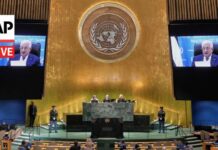

Dozens of diplomats walked out as Israel’s leader defended military actions at the United Nations, turning a policy speech into a public test of legitimacy.
Story Highlights
- Benjamin Netanyahu said Israel “has every right” to remove threats and protect civilians.
- Dozens of United Nations delegates staged a walkout during the address.
- United Nations human rights officials later alleged serious law-of-war violations in Gaza and the West Bank.
- The clash shows how global optics can crowd out debate on facts and law.
What Netanyahu Said In The Hall
Prime Minister Benjamin Netanyahu told the United Nations on September 27, 2024, that Israel acts in self-defense and must remove cross-border threats to keep citizens safe. He said, “Israel has every right” to do so and argued that attacks had pushed Israel past its limit, saying, “enough is enough”. Before the trip, he said he would fight “horrible lies” against Israeli troops and stand up for Israel Defense Forces soldiers. These lines framed Israel’s actions as lawful and necessary.
The official United Nations transcript preserves his words and intent, giving a contemporaneous record of his defense. He tied current operations to a longer pattern of Israeli policy that stresses duty to protect civilians. In past United Nations speeches, he used similar language about doing “whatever it must” to defend Israel. These records establish what he claimed and why, but they do not by themselves prove each strike met legal tests of necessity or proportionality.
How The Room Responded
As Netanyahu took the podium, many delegates stood and left. Reporters on scene counted “dozens” of envoys exiting, leaving many empty seats for the rest of the speech. The Palestinian Mission had urged delegations to walk out to reject what it called “genocide and war crimes and illegal occupation,” using the protest as a public signal. The visual dominated coverage. Cameras showed the departures, and headlines focused on the spectacle over the legal points inside the speech.
Walkouts at the United Nations are not new, but they carry weight because they turn moral claims into images. Supporters of Israel saw the protest as grandstanding and proof of bias. Critics saw it as a needed rebuke. Either way, the effect was the same: the argument about self-defense moved offstage while attention locked on the empty chairs. That kind of optics war can deepen public mistrust in institutions on both sides of the aisle.
The Human Rights Clash After The Speech
United Nations human rights officials later issued sharp condemnations. The United Nations human rights chief, Volker Türk, said Israel’s Gaza campaign “consistently breached international law” and showed “unprecedented disregard for human rights” while presenting a formal report. A separate United Nations News account said killings and destruction continued after a ceasefire and described forcible displacement in the West Bank as “unseen in decades,” alleging war crimes and possible crimes against humanity by multiple parties.
Israel's Ambassador to the UN Danny Danon approached the head of the Iranian delegation to the UN at the end of Prime Minister Benjamin Netanyahu's speech and tried to give him the Starlink router that Netanyahu displayed during his speech.
He refused it. 😂
— John The Main Guy (@JohnTheMainGuy1) September 24, 2026
These charges are serious and specific, but they are still allegations that require incident-level proof. Netanyahu’s camp points to ongoing attacks from armed groups and Iran’s role to justify action. The gap is clear. Netanyahu’s side offers claims of necessity and defense, supported by transcripts and statements. United Nations bodies cite large-scale patterns of harm and rights breaches. Both can be documented. What is still thin in public is shared, detailed evidence for each strike and operation.
Why This Moment Matters At Home
Americans who think global elites protect their own will see the walkout as more theater than truth. Others, who think great powers dodge rules, will see it as overdue pushback. Both groups worry that big institutions avoid hard facts. The fix is not more showdowns. It is records. Cabinet minutes, legal reviews, target files, and civilian-harm assessments would let voters judge necessity and restraint for themselves. Without them, trust erodes, and images win over evidence.
Sources:
cbsnews.com, reuters.com, gadebate.un.org, gov.il, ynetnews.com, europarl.europa.eu, canberratimes.com.au
© patriotnews.net 2026. All rights reserved.